La nuit vivante
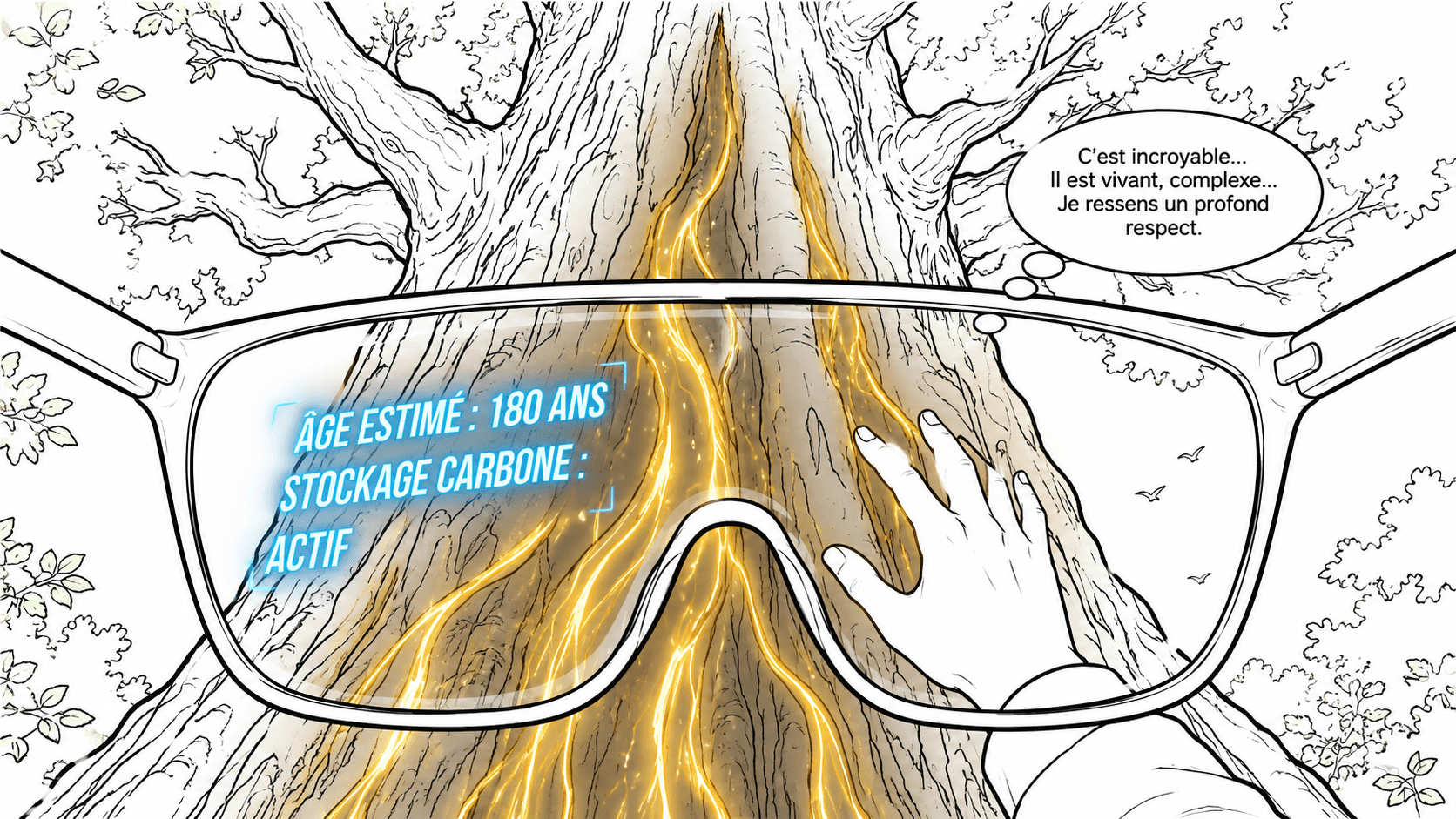
An AR night-vision concept prototype that turns the presence of Compiègne forest’s unseen creatures — at night — into something you can actually perceive.
UX research
Field research
Storyboarding
Ideation workshop
AR concept
Prototyping
Context
ICX1 (Introduction to Eco-design) course project, UTC
Team
Blanche Nguyen · Edgar Djeuga · Gakuto Sasabe · Shiqi Yu
My role
Field research, literature research, interviews, user testing, and the final prototype concept
Research
31-person survey · 2 semi-structured interviews · storyboard concept test with students
Context, problem, hypothesis
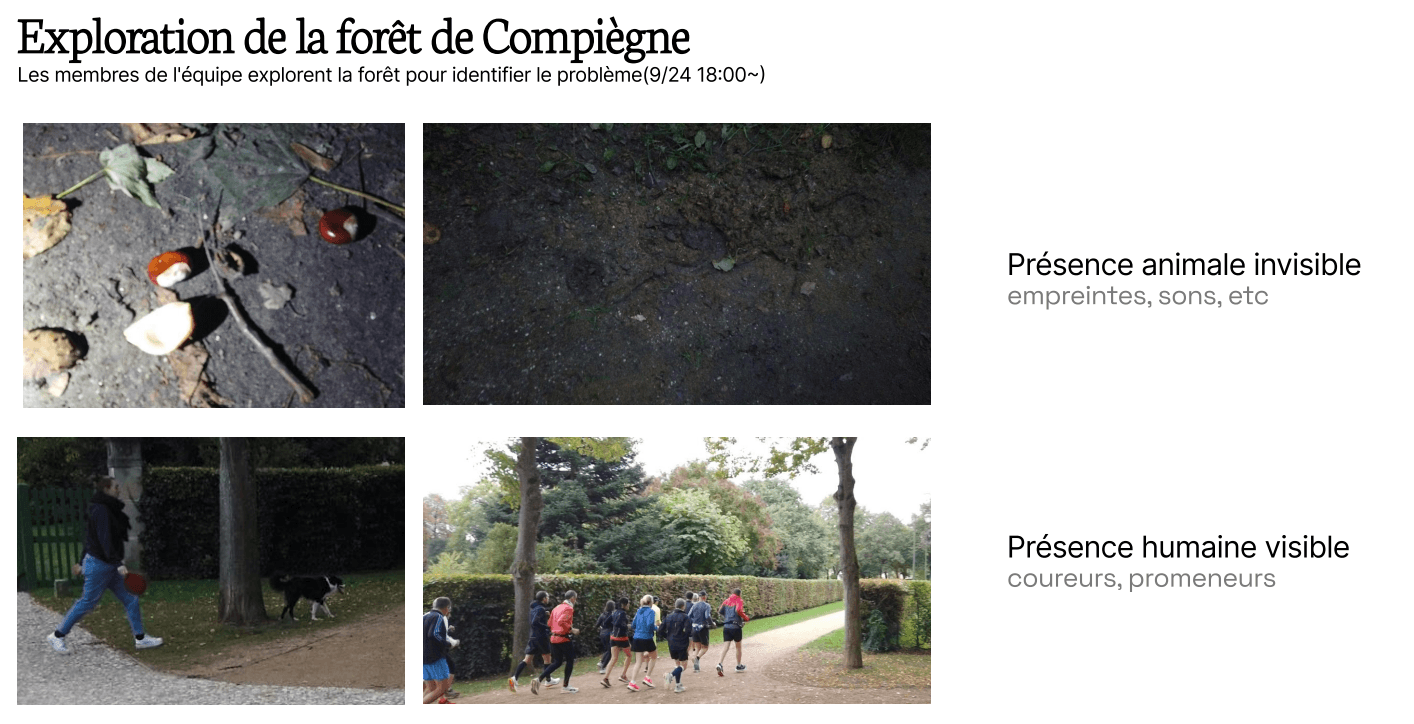
For UTC’s ICX1 (Introduction to Eco-design) module, our brief was “the night experience of every living creature in Compiègne.” A night walk through the forest surfaced a gap: animal presence — footprints, sounds — was real but almost impossible to perceive in the dark, while human presence — joggers, walkers — stayed clearly visible.
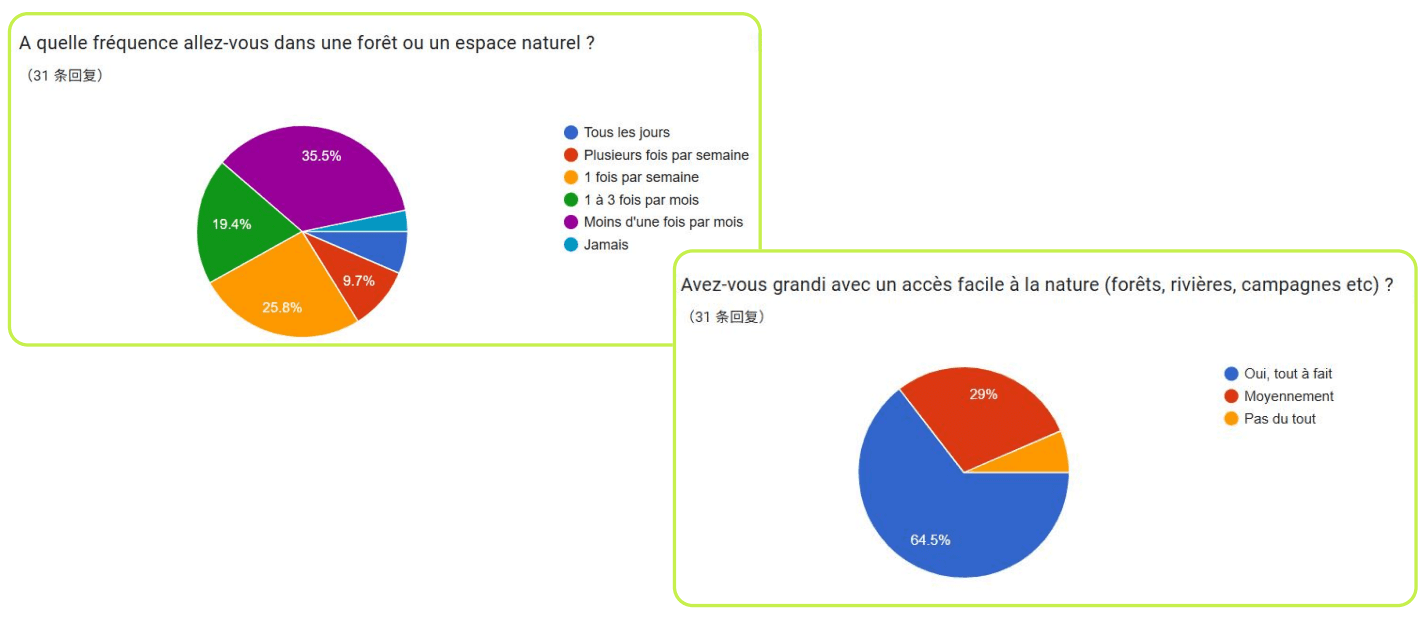
Reading around “the extinction of experience,” alongside Studio Ghibli’s recurring themes of human/nature conflict, unchecked urbanization and nature’s resilience, reframed how we thought about city dwellers’ relationship with nature. A 31-person survey found 74.2% reported their relationship with nature had changed significantly, driven mostly by urbanization (77.4%) and screen time (71%).
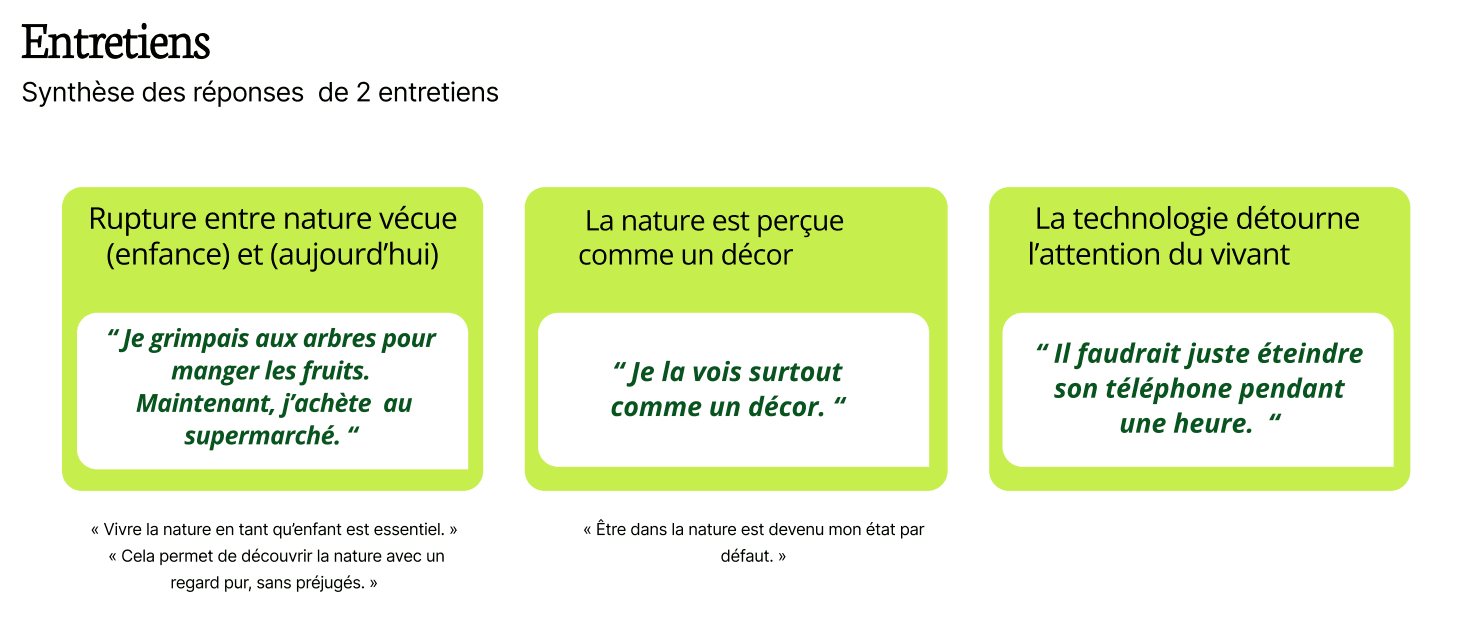
Two further interviews surfaced the same disconnect: “I used to climb trees and eat the fruit as a kid; now I just buy it at the supermarket,” “nature is just scenery to me now.”
Hypothesis. Night nature — hard to perceive under darkness, fear and digital habit — could be felt as alive again through emotion and direct experience.
Role and collaboration
A four-person team at UTC’s ICX1 module — Blanche Nguyen, Edgar Djeuga, Gakuto Sasabe and Shiqi Yu — working from a shared eco-design brief.
Field research
I led the night forest walk and surfaced the project’s founding insight: the asymmetry between animal presence (footprints, sounds) and human presence.
Research & interviews
I gathered the “extinction of experience” literature and Studio Ghibli references, then ran two interviews that surfaced the gap between childhood nature experience and now.
User testing
I designed and ran the storyboard concept test. Its key insight — make the concept more physically legible — reshaped the final prototype.
Prototype concept
I took the idea from an early “bubble” concept to the final portable AR glasses: OLED see-through display, directional mic, night-vision camera, Bluetooth/Wi-Fi, Arduino control.
Working end-to-end — from the first-hand insight in the forest, through testing, to the prototype concept — kept the research and the design decisions connected the whole way through.
Process
Field to concept, six steps
Framing the brief
Set out from the theme “the night experience of living creatures in Compiègne,” defining the goal: discover a problem and propose a concept.
Field research
Explored the forest at night and found the core asymmetry: animals imperceptible in the dark, humans clearly visible.
Literature & survey
Built a reference frame from “extinction of experience” writing and Studio Ghibli, then ran a 31-person survey and two interviews to unpack the shift in people’s relationship with nature.
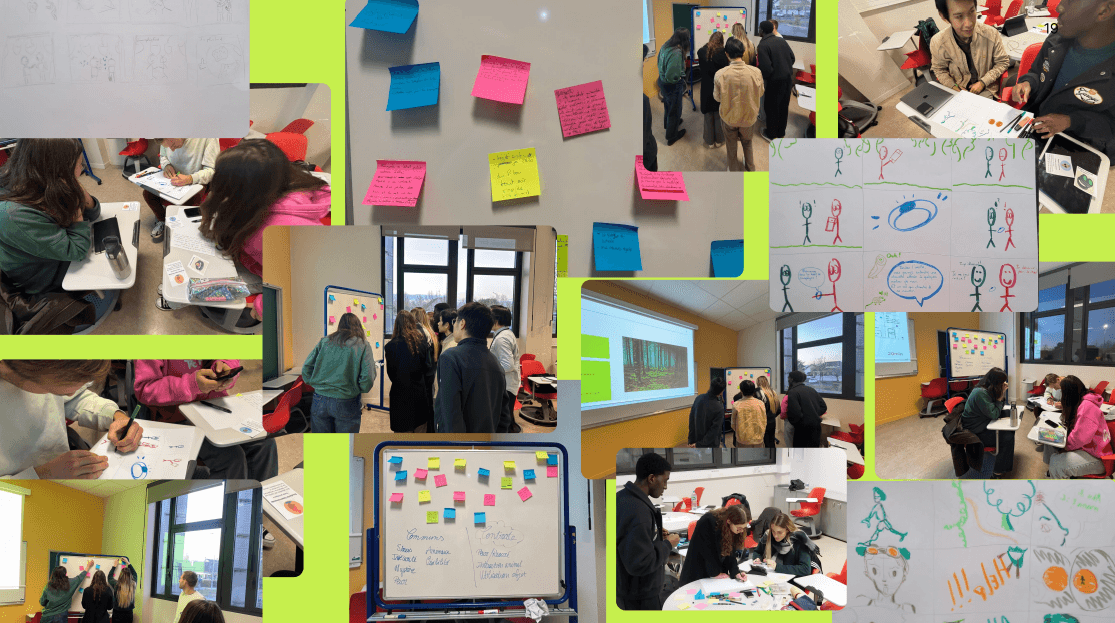
Immersive ideation workshop
Five stages — persona and object choice, simulated night-forest immersion, sharing, paired scenario writing, a 6–8 panel storyboard — surfaced the barriers (fear, discomfort, poor visibility) and the direction: amplify the senses.
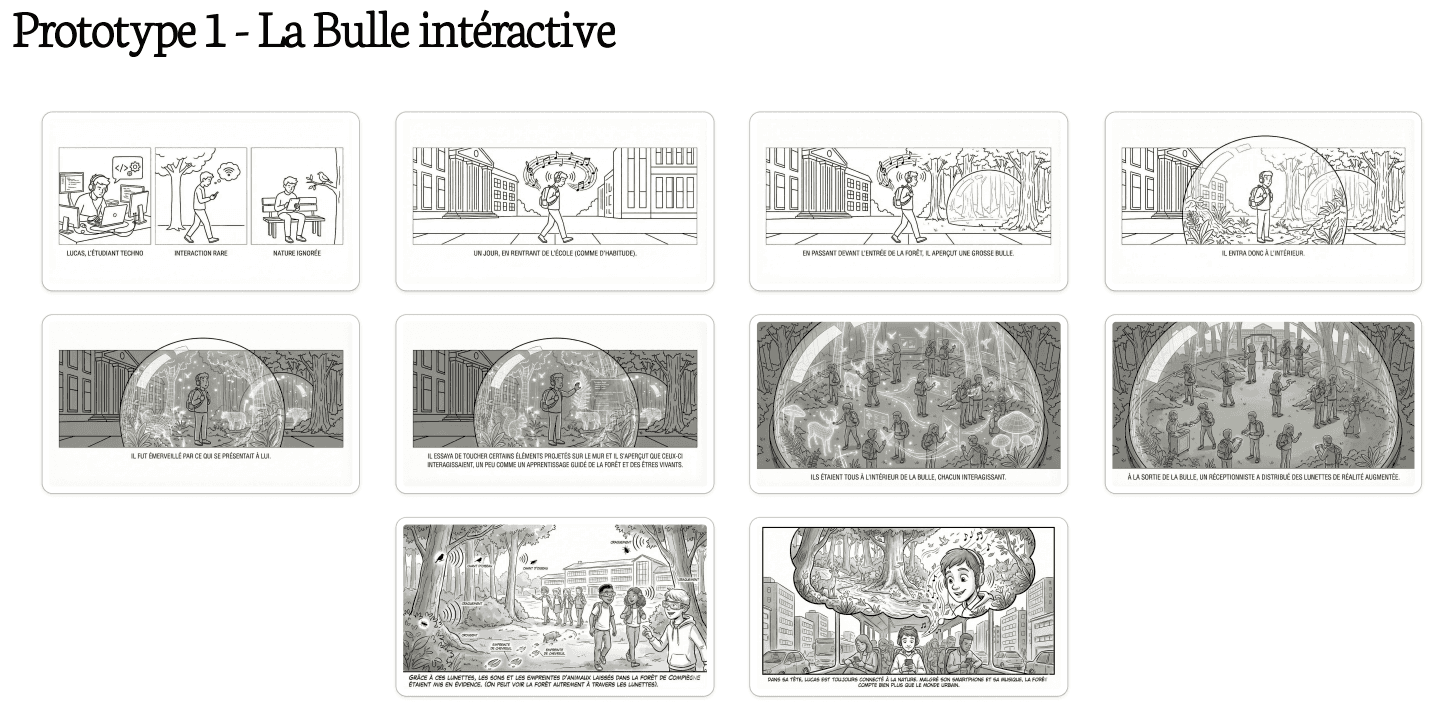
Lo-fi concept test — “La Bulle interactive”
A digitally-saturated student steps into a glowing bubble at the forest edge, experiences projections of the forest’s creatures, and receives AR glasses on the way out. Tested with 18–30-year-old students: well received, with one clear note — make the device more physically legible.
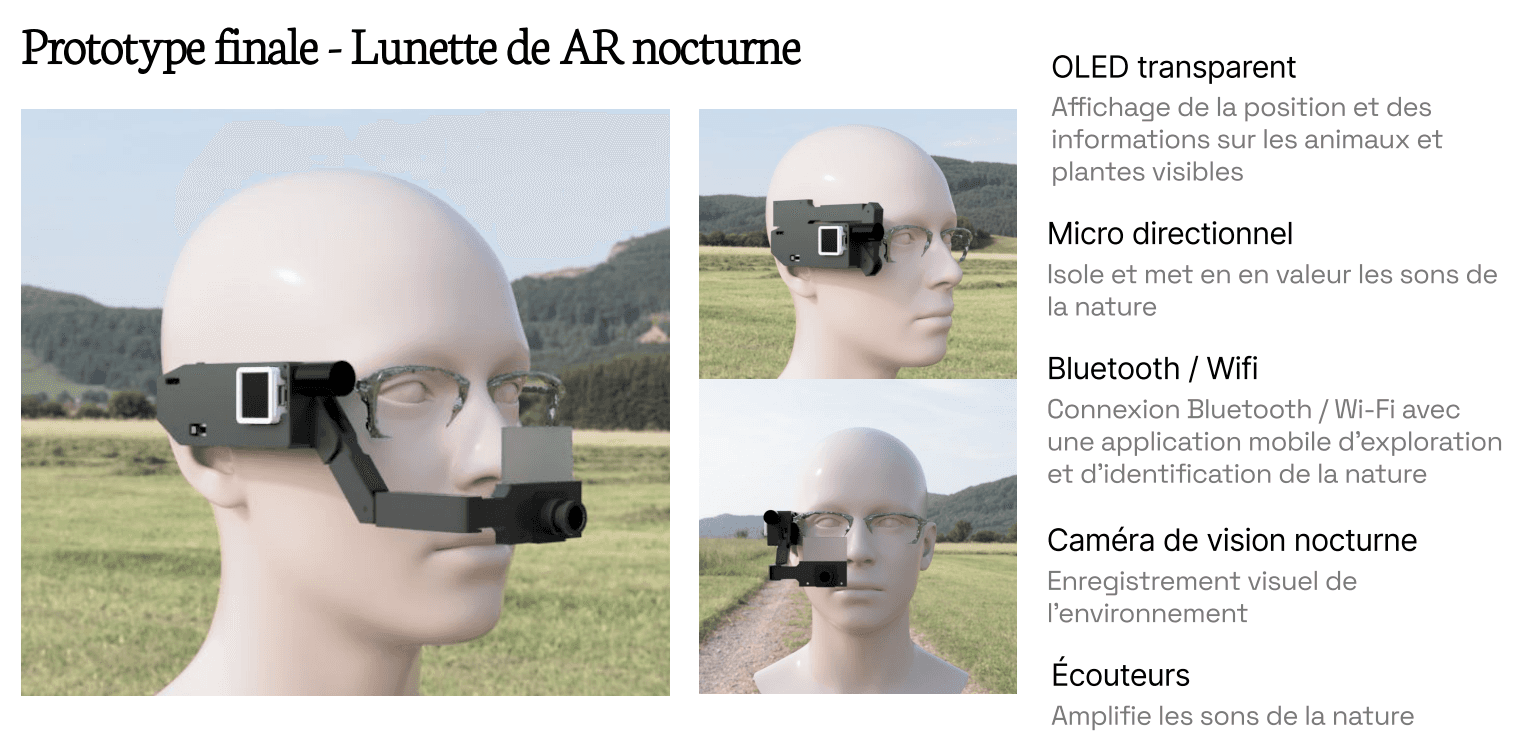
Final prototype
The “bubble” evolved into portable night AR glasses: OLED see-through display, directional mic, night-vision camera, Bluetooth/Wi-Fi companion app, earphones, Arduino control.
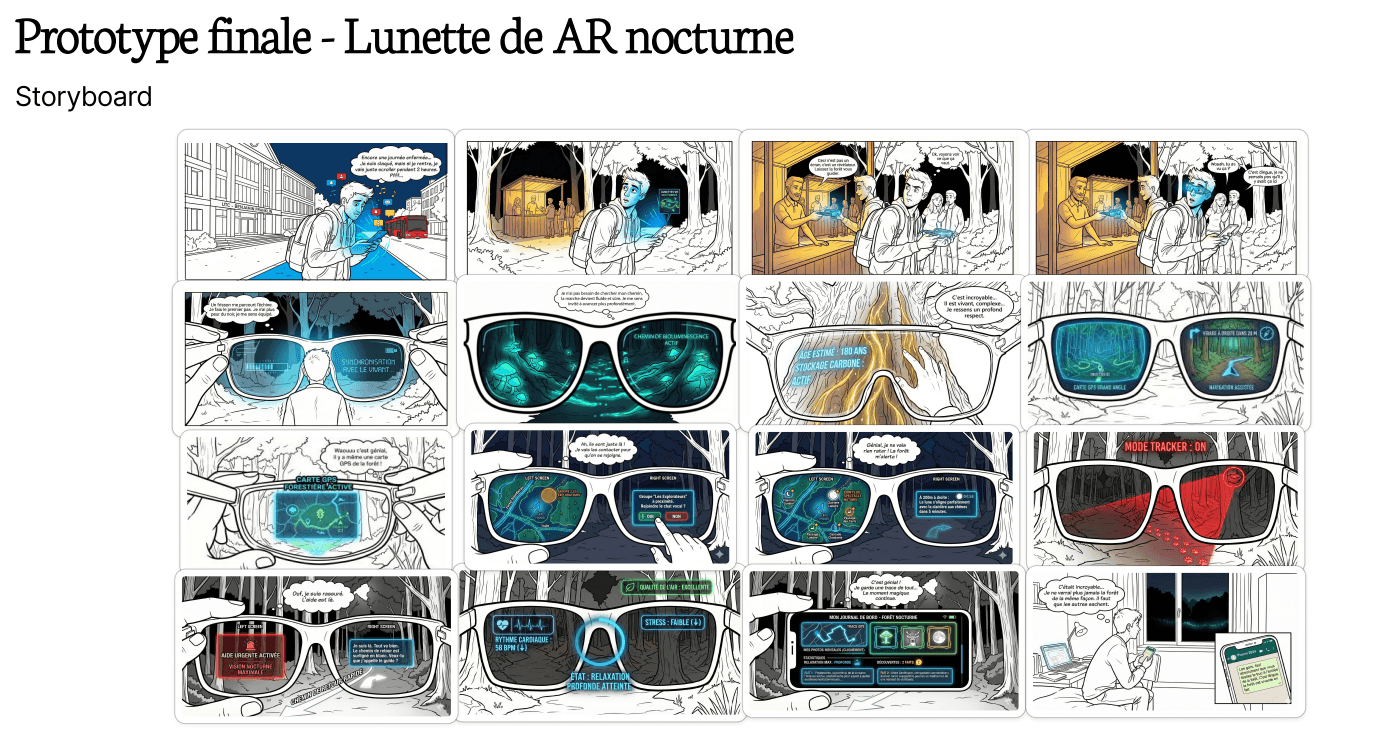
What the solution does
The final AR glasses make the forest’s night life perceptible in three ways:
Extend sight
OLED see-through display overlays nearby plant and animal information; a night-vision camera reveals footprints and other traces.
Extend hearing
A directional microphone isolates and lifts natural sound, delivered through earphones.
Lead with story
The storyboard — a student wrapped in their phone and music meets something strange at the forest’s edge — uses technology as a doorway, not a destination.
Not just a night-vision device — the aim was redesigning the forest from background scenery into a community of creatures worth respecting.
Results
Concept test, 18–30, Compiègne students
Participants responded with curiosity and openness; the storyboard was called immersive, poetic and easy to follow and imagine.
Reaction to AR
Seen as a credible way to perceive night nature better, alongside a clear note that the concept needed to be made more physically legible.
This fed directly into moving the prototype from the “bubble” toward portable AR glasses, testing the concept’s reception and locating the next design problem to solve.
Limits and learning
Testing was limited to students; children, local residents and forest rangers haven’t been part of the research yet.
The test conditions themselves — night, forest, low visibility — constrained how much research could be run.
Field visits to the forest were limited in number, so seasonal and time-of-day differences are still untested.
Next steps: repeat the immersion across seasons and times of day, work with ecologists and engineers, and simplify the device further so it stays close to the senses rather than adding technology on top of them.