M5 Scouter
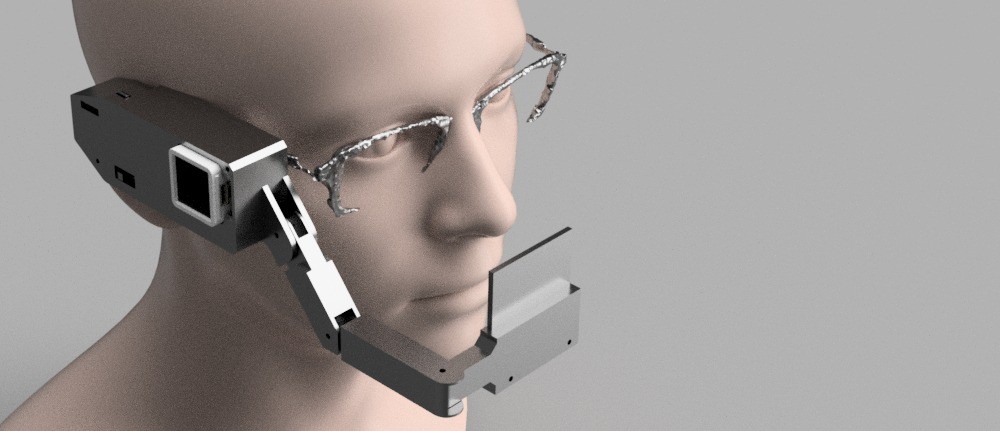
A home-built AR device that clips onto your glasses, aimed at a price anyone can afford. It shows speed and direction while you run, and a Pomodoro timer in your field of view.
M5Stack ATOMS3
GPS
Fusion 360
3D scanning
Arduino / PlatformIO
Solo project
Platform
M5Stack ATOMS3 with a GPS unit
Power
500 mAh LiPo battery, about 3 hours per USB-C charge
My role
Everything, alone: planning, hardware design and firmware
Released
Completed on July 31, 2024; entered in the M5Stack Japan Creativity Contest 2024
Background and technical challenge
Commercial AR glasses are expensive and hard to get. That raised a question: could I build an AR device that is cheaper, and that anyone can develop for? I started the project on my own from there.
One trigger was how annoying it is to lift your arm to check a smartwatch while running. That grew into the idea of showing information in the corner of your vision, and then into the concept of an everyday AR device like the “scouter” in Dragon Ball.
The technical core was to combine an inexpensive microcontroller module like the ATOMS3 with a small, light mechanism that can be added to glasses afterwards.
Challenge. A cheap microcontroller module and a small, light, add-on mechanism for glasses — both at once.
Role and scope
A personal project — I am the only member registered on ProtoPedia. I handled everything alone, from planning through hardware design to firmware.
Body design
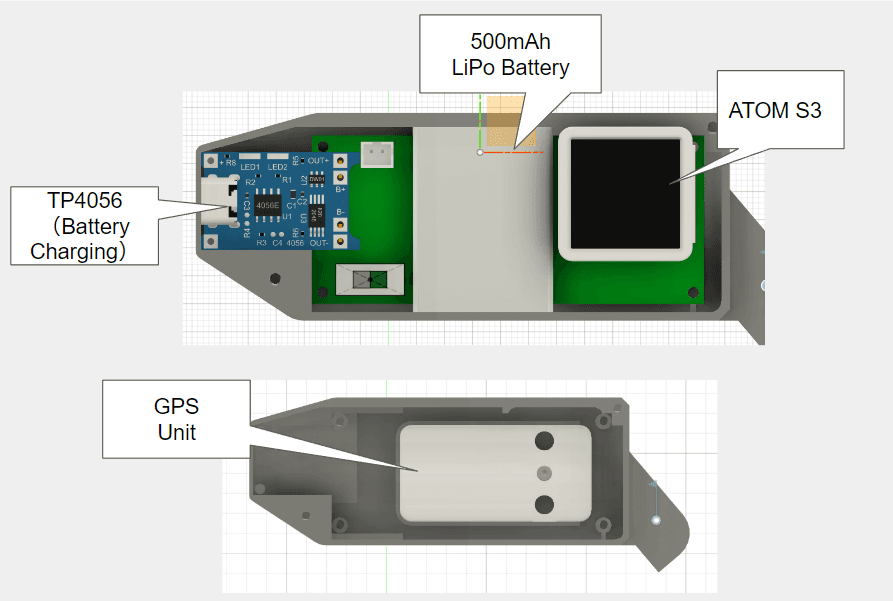
Worked out the circuit: ATOMS3, a 500 mAh LiPo battery, a TP4056 charging board and a GPS unit.
Enclosure and mechanism
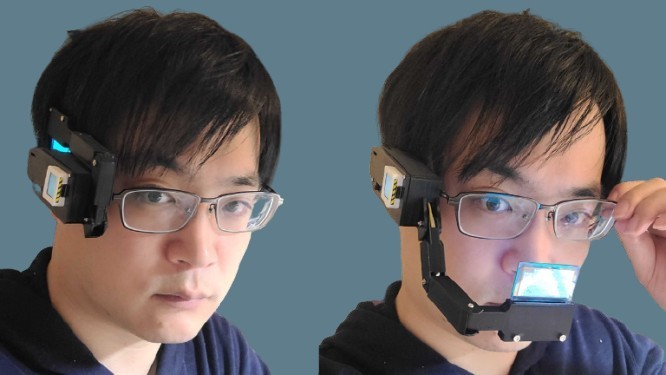
Designed in Fusion 360 a mechanism that attaches to glasses and folds away.
Firmware
GPS communication, and controls using head direction plus a push switch on the side.
Applications
Running Vision (speed and direction to a destination) and Pomo Watch (Pomodoro timer).
Technology and architecture
Core board
M5Stack ATOMS3. Swapping in another ATOM, such as ATOM Echo, adds a microphone or speaker.
Power
500 mAh LiPo battery and a TP4056 charging module; about 3 hours per USB-C charge.
Location
GPS unit (AT6558) connected over UART.
Controls
Head direction plus a push switch on the side of the unit.
Mechanism
Clips onto any glasses, and folds away when it blocks your view.
Tools
Arduino / PlatformIO, Fusion 360 for CAD, and RealityScan (phone 3D scanning) to reproduce real glasses.
What took some care
A whole day lost to GPS communication. Connected to an ATOM Echo, the official sample code kept resetting the board. The module’s default serial pins didn’t match; passing the Grove port’s RXD/TXD pin numbers the opposite way round, as actually wired, fixed it.
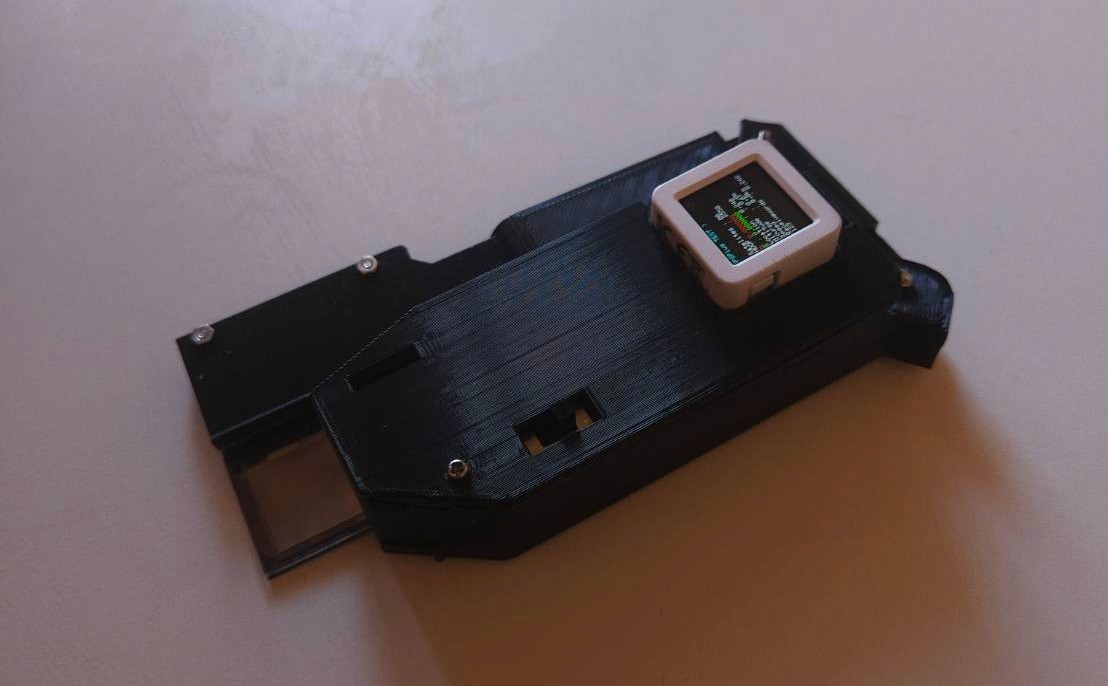
“It doesn’t look cool” — solved by my wife’s idea. With the GPS unit on the front of the board the whole thing looked stretched. Stuck on my own, I got a suggestion from my wife, who has no technical background: put the GPS unit behind the board so everything gets shorter. It improved the look a lot.
Reproducing my own glasses exactly. I 3D-scanned my glasses with RealityScan on a phone and imported them into Fusion 360. Placing the AR unit on a real-size glasses model let me check the wearing balance as I designed.
Results and impact
M5Stack Japan Creativity Contest 2024
Entered, and completed and published on July 31, 2024.
External reaction
After being published on ProtoPedia, it was introduced on YouTube by third-party creators.
Two working apps
Running Vision and Pomo Watch, built to the point of really working, at a lower cost than off-the-shelf products.
Learnings and next steps
Hardware development is a pile of small stumbles across different layers — electrical connections (pin assignment), heat, software setup — and takes the persistence to solve them one by one. I was reminded of that.
Running Vision and Pomo Watch are both still in development, and I can already see features to add, such as a warning when you run with poor posture.